
Organizations measure a lot when it comes to learning.
Course completion, quiz scores, attendance, satisfaction, and self-assessment all provide useful information. They help us understand whether people participated, engaged with the material, and understood what was taught.
But they still leave one important question unanswered:
Can people actually apply what they learned on the job?
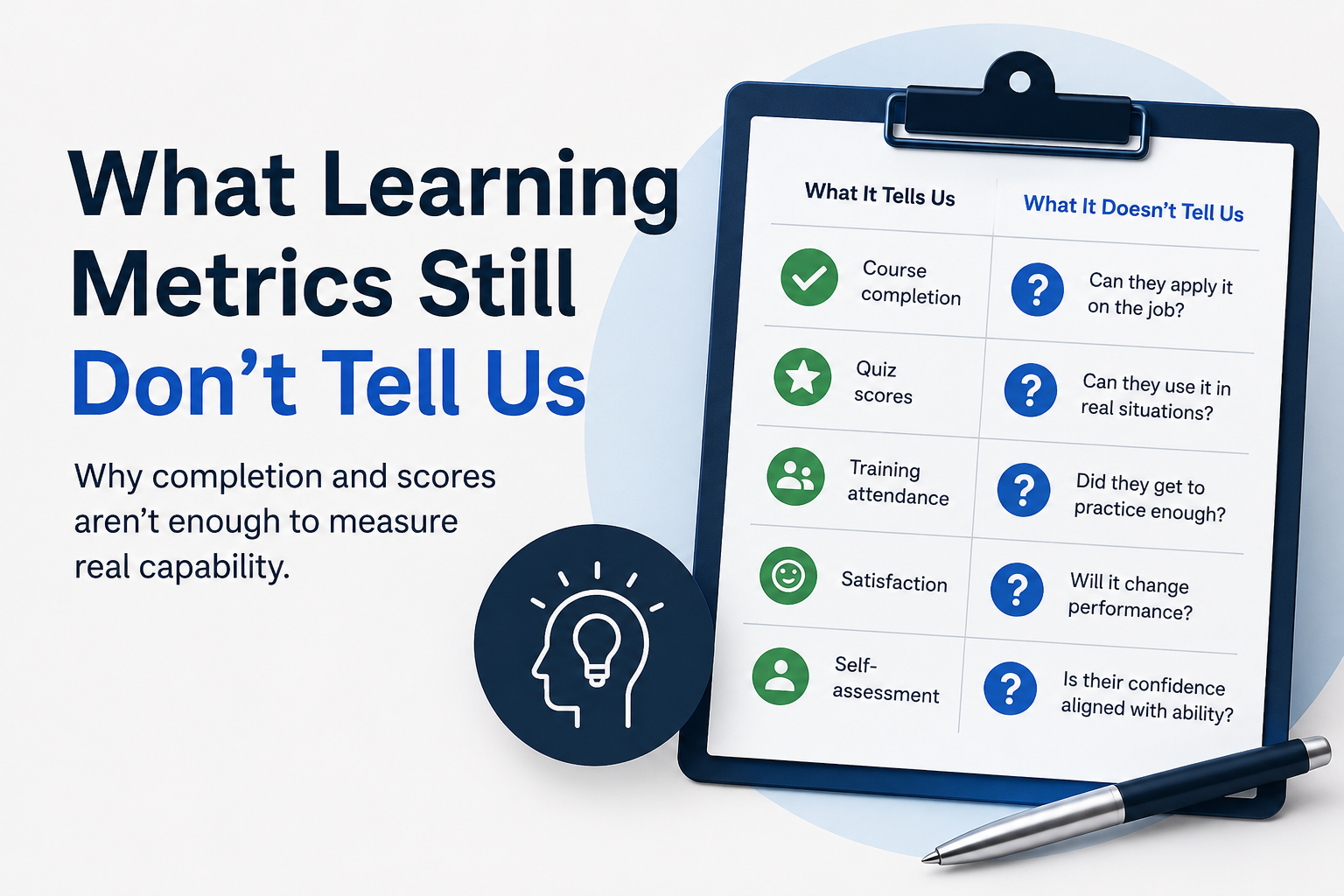
The infographic below looks at what common learning metrics tell us, and what they cannot show on their own.

The gap between learning and capability
The metrics in the infographic are not bad metrics. Each one serves a purpose.
Completion tells us that someone reached the end of a course. Quiz results can indicate knowledge or understanding. Attendance confirms participation, while satisfaction and self-assessment help us understand the learner’s experience and perception.
The limitation is that these measures are usually indirect.
They tell us about learning activity, but not necessarily about workplace performance.
An employee may understand how to handle a difficult customer and still struggle during a real conversation. A manager may know the principles of effective feedback but find it difficult to use them when an employee becomes defensive. A salesperson may remember an objection-handling framework without being able to apply it naturally under pressure.
Knowing is important, but skill is demonstrated through action.
What should we measure in addition?
To understand whether learning has become real capability, people need opportunities to apply skills in realistic situations.
That means observing how they respond, what decisions they make, where they hesitate, and how their performance changes after feedback and repeated practice.
This type of evidence can help organizations answer more meaningful questions:
- Can employees apply the skill in context?
- Where are the most important performance gaps?
- Who needs additional practice or coaching?
- Are people improving over time?
- Is training changing what people can actually do?
This does not mean replacing traditional learning metrics. It means adding another layer to them.
Completion, knowledge, and satisfaction can show that a learning experience took place. Practice and performance data can help show whether it made a difference.
Making skill development more visible
myQuest Skills gives people a way to practice realistic workplace situations, receive feedback, and improve through repetition.
At the same time, it gives managers and L&D teams clearer visibility into performance, skill gaps, and progress over time.
The goal is not simply to measure whether learning happened.
It is to understand whether people can now do something better on the job.

.png)



.png)


