
Ask five leaders in the same company what “skill building” means and you will likely get five answers: a course catalog, an annual training week, a certification, a learning portal, a mentoring program.
All of these can be part of it. None of them is the thing itself.
A working definition
Skill building is helping people get measurably better at doing something specific in their job.
Each part of that sentence matters:
- Measurably. Someone can see the improvement, not just assume it.
- Better at doing. The target is action, not knowledge.
- Something specific. Handling a pricing objection is a skill. “Communication” is a category.
What skill building isn’t
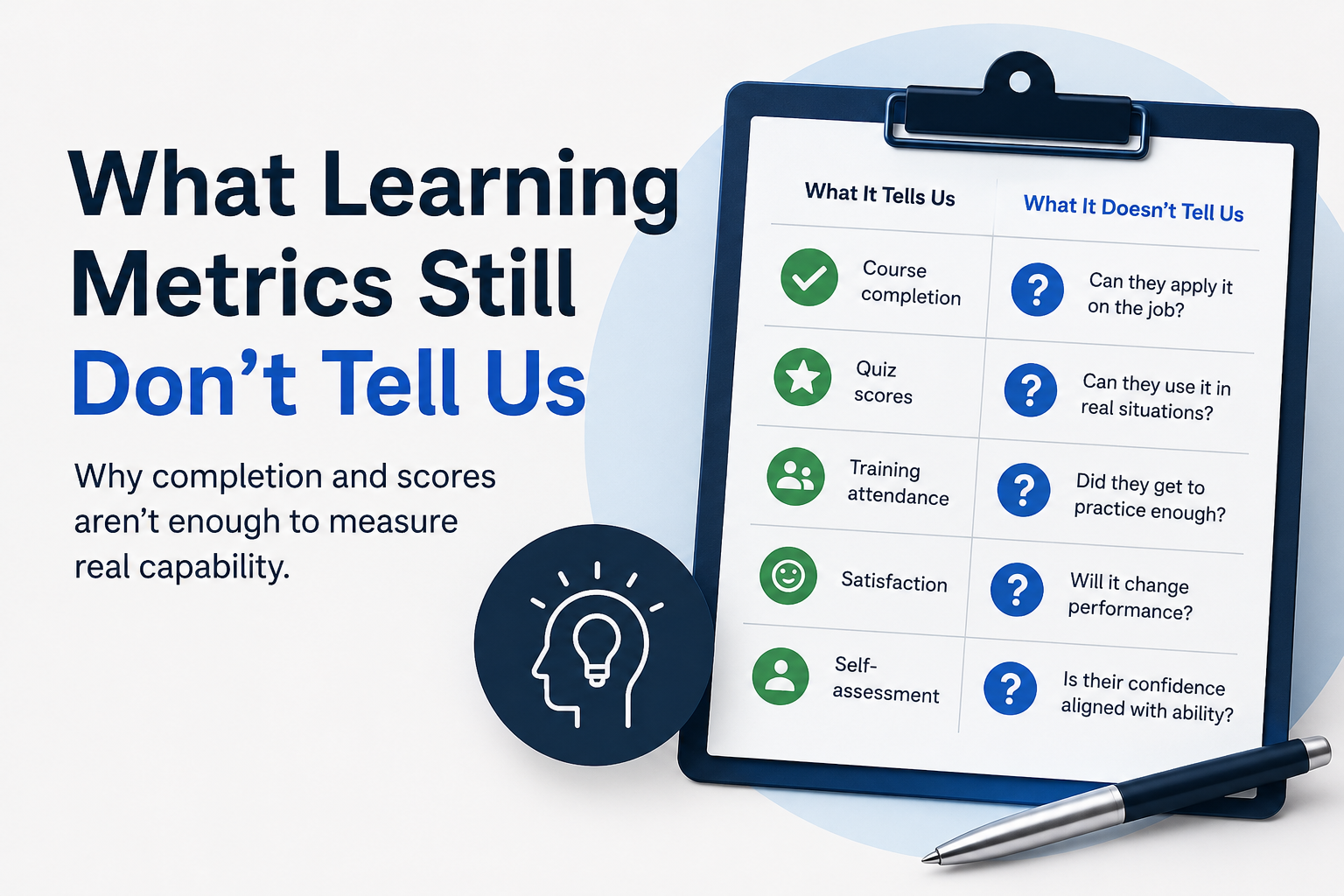
It isn’t training attendance. Showing up tells you someone was in the room.
It isn’t knowledge. Someone can explain a feedback framework perfectly and still freeze when an employee gets defensive.
It isn’t a content library. Access to material creates the possibility of learning, not the evidence of it.
It isn’t a one-time event. A workshop can start a skill, but skills are built through repetition over time.
How skills actually develop
The pattern is the same whether the skill is sales, coaching, or customer service: learn the idea, try it in a realistic situation, get specific feedback, and try again.
Most organizations are strong on the first step and thin on the other three. Practice and feedback are where capability is built, and they are usually the hardest to scale.
Why the definition matters
How you define skill building decides what you measure. If you define it as training delivered, you will measure completion rates, and those will look healthy while performance stays flat. If you define it as people getting better at specific things, you will start asking different questions: Who can do this today? Who is improving? Where are the gaps that affect results?
Those questions are the foundation for everything else in this series: measuring capability, mapping skills across the organization, and connecting skill data to business outcomes.
Where to start
You don’t need a company-wide program to begin. Pick one skill that matters to one role. Describe what good looks like in a real situation. Give people a way to practice it and see how they do. That single loop gives you more insight than another round of course completions.
Next in this series: skills, competencies, and capabilities, and why the difference matters when you start measuring.