
No one approves a budget line called "skill gaps." There is no invoice, no vendor, no monthly report. Yet the cost is real, and it is paid every day in small amounts that nobody adds up.
A gap is simply the distance between what a role needs people to do and what they can reliably do today. When that distance is large, the organization pays for it somewhere. The trouble is that the payment is hidden inside other numbers.
Where the cost actually shows up
Skill gaps rarely announce themselves. They show up as ordinary operational problems with other names.
- Rework. A proposal goes back twice, a ticket is reopened, a report is rewritten. Each loop costs someone's time, and the time was spent twice.
- Slow ramp-up. New hires take longer to work independently because nobody is sure which skills they still lack.
- Lost or shrunken deals. A rep who cannot handle a pricing objection discounts early or stalls the conversation.
- Customer churn and escalations. A service agent who cannot calm a frustrated customer hands the problem to a manager, and sometimes loses the customer.
- Manager time. Leaders step in to fix work that should have been done right the first time.
None of these lines in the budget says "skill gap." That is why the gap survives.
Why training spend hides the problem
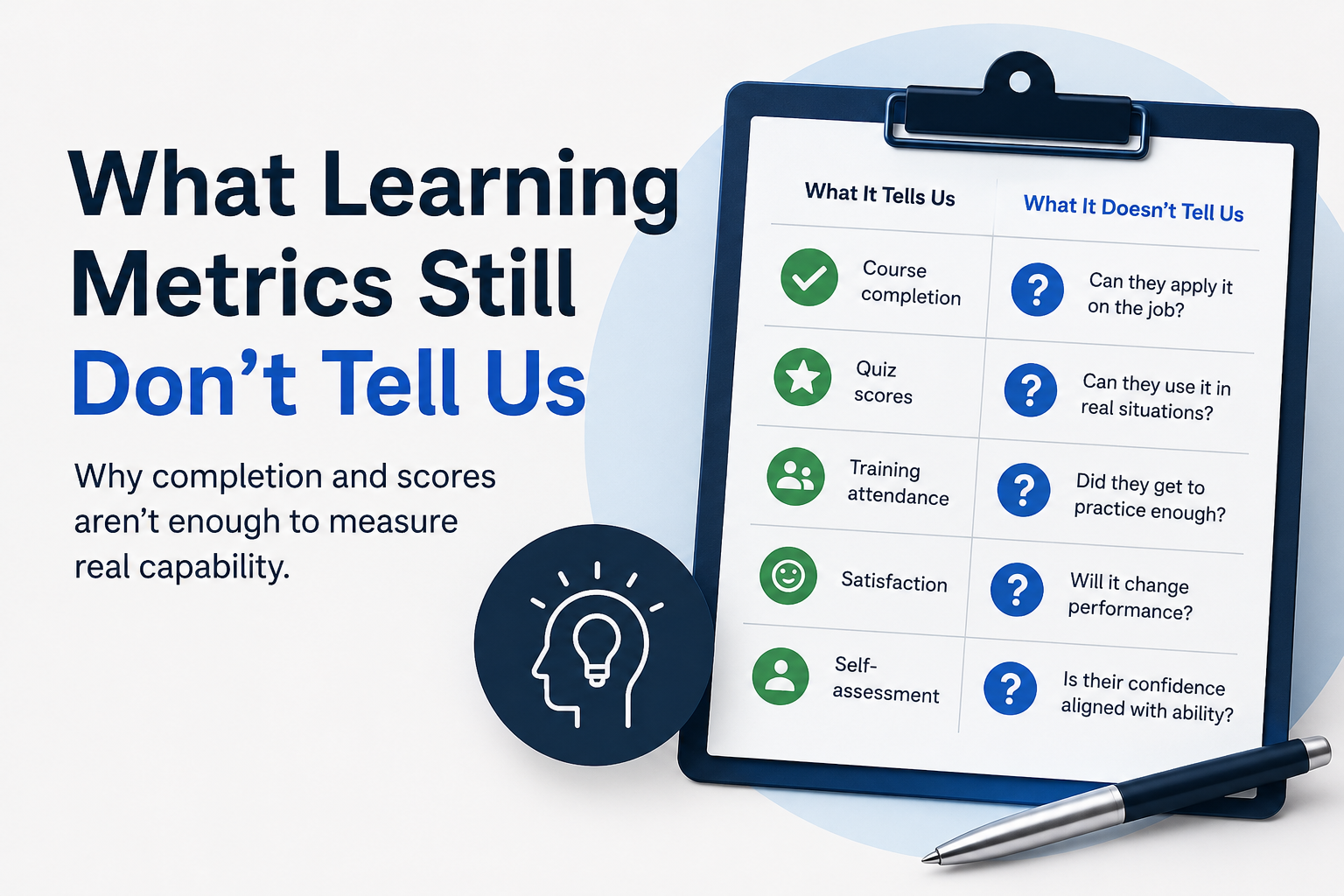
Most organizations do spend on development, so it is tempting to assume the gap is being handled. But money spent on training tells you what was delivered, not what changed. As we described in what skill building actually means, completion and attendance are not evidence that someone can do something better than before.
A team can finish every course and still struggle on the job. The cost then doubles: you paid for the training, and you still pay for the gap.
Why the cost stays invisible
There are three common reasons.
Skills are measured at the wrong level. Broad labels like "communication" or "leadership" are too general to act on. Name the specific skills inside them. If you cannot say which specific skill is weak, you cannot say what it costs. We covered how skills, tasks, and what a team can reliably do relate to each other in how skills and capabilities differ. The short version: gaps are easiest to find and fix at the level of a specific skill.
Self-reports are optimistic. Asking people to rate themselves tells you how confident they feel. It does not tell you how they perform in a tense conversation.
Results arrive late. A quarterly number moves months after the behavior that caused it, so the link between the two is easy to miss.
A simple way to put a rough cost on one gap
You do not need a precise figure to make the case. You need a defensible, rough one for a single skill. Try this:
- Pick one skill tied to a result you already track, such as handling pricing objections or de-escalating a complaint.
- Name the business moment where the skill matters: the renewal call, the first week on the job, the escalated ticket.
- Ask the people closest to the work what happens when that moment goes badly. List the consequences in plain words: a discount, a repeat contact, a manager pulled in.
- Estimate how often it happens and what each case costs in time or revenue, using numbers you already have.
Treat the result as an estimate, and say so. A rough number from your own data is more useful than a borrowed statistic from someone else's industry.
Closing the gap takes practice, not just content
Once a gap has a name and a rough cost, the fix is the same pattern we described earlier in this series: people try the skill in a realistic situation, get specific feedback, and try again. That loop is what turns knowing into doing. A new slide deck rarely does.
It also gives you something training attendance cannot: evidence. If people practice the same real work situation and their performance improves, you can see the gap narrowing. If it does not, you learn that early, before the cost compounds.
Where to start
Choose one role and one skill that affects a result you care about. Write down what good looks like in a real situation. Have people practice it, give them feedback, and look at how scores change over a few weeks. One measured gap is enough to start the conversation about the others.
myQuest Skills is one way to do this. It lets people practice realistic work situations with AI simulations and get feedback, and it shows managers where people are improving and where gaps remain.
Next in this series: the skill lifecycle: acquire, apply, maintain, retire