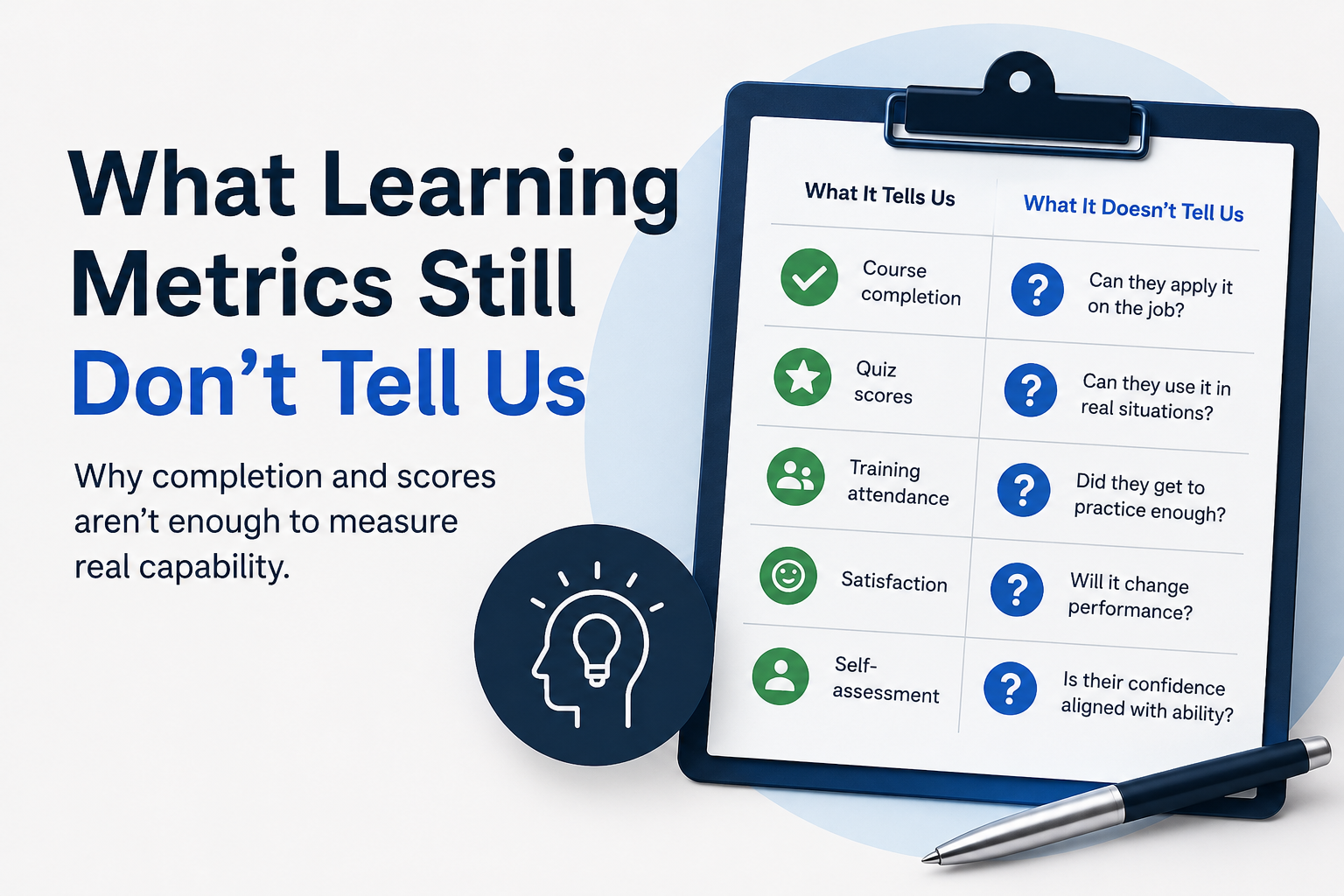

Most organizations treat a skill like a one-time delivery. Someone attends a workshop, ticks a box, and the skill is assumed to be installed for good. Anyone who has tried to use a language they studied years ago knows how that story ends.
Skills have a life. They are acquired, applied, kept sharp, and sometimes set aside when the work changes. Seeing all four stages helps you decide where to spend time, and where your current approach quietly stops.
Stage one: acquire
This is where most development budgets go. A person sees a new way of doing something and tries it for the first time. Content, demonstrations, and examples all help here.
But acquiring is only the start. As we described in what skill building actually means, a skill is not built by exposure. It is built by doing the thing, getting feedback, and doing it again. A person who has watched a demo has not yet acquired the skill. They have seen one.
Stage two: apply
A skill becomes real when it is used in a situation that resembles the job. That means a live customer call, a difficult conversation with a team member, or a realistic practice scenario where the stakes feel close to the real thing.
This stage is where the first honest evidence appears. Can the person handle the pricing objection when the customer pushes back? Can they explain a change without losing the room? Feedback at this point is most useful, because the attempt is fresh and the gap is specific.
Many programs skip this stage or leave it to chance. That is one reason the gaps described in why skill gaps quietly cost organizations money persist even after people finish training.
Stage three: maintain
Skills fade when they go unused. A person who handled escalations well last spring may be rusty after months of routine tickets. A manager who gave strong feedback during a training week may slide back into old habits under pressure.
Maintenance does not need to be heavy. It looks like short, regular practice on the moments that matter most, plus feedback from someone who can see the work. The aim is to keep a skill dependable, not to retrain it from zero.
Maintenance is also where a team's overall ability is protected. In how skills and capabilities differ, we described a capability as what a team can reliably do. That word, reliably, depends on skills staying in good shape across many people, not just on the day they were taught.
Stage four: retire
Some skills stop mattering. A tool is replaced, a process changes, a product line ends. If nobody retires the skill, it stays in training plans, assessments, and role descriptions long after the work has moved on.
Retiring a skill is a decision, not a drift. It frees time and attention for the skills that carry weight today. It also keeps your picture of what people can do honest, because you stop counting abilities the business no longer uses.
Where organizations get stuck
Most programs are strong at the first stage and thin at the other three. People acquire, then the trail goes cold. Nobody checks application, nobody plans maintenance, and nobody retires anything. The result is a long list of skills that look present on paper but are uneven in practice.
A simple test: for any skill you care about, ask who can show it today, when they last used it, and what you would see if it had faded. If the answers are guesses, the lifecycle is incomplete.
Where to start
Pick one skill that matters to a result you track. Write down what each stage looks like for it. How will people first try it? Where will they apply it in a realistic situation? How often will they practice to keep it sharp? What would make you retire it?
Then add feedback at the apply and maintain stages, since that is where most programs have the least. Even a small loop of practice, feedback, and another attempt will tell you more than a completion report.
myQuest Skills is one way to do this. It lets people practice realistic work situations with AI simulations and get feedback, and it shows managers where people are improving and where gaps remain.
Next in this series: knowing vs. doing: why knowledge isn't skill