
Ask a team how good they are at handling a difficult customer, and most people will say "pretty good". Ask their manager, and the answer may be a little different. Give them a short test, and you will get a third answer. None of these is wrong. Each one measures something different.
If you want to know who can actually do a job well, you need to be clear about what each method can and cannot tell you.
Start with what you are trying to measure
As we covered in knowing vs. doing, recalling an idea and performing it are different things. So the first question is not "which tool should we use?" It is "do we need to know what someone understands, or what they can do?"
Most organizations need the second. That shapes how much weight each method deserves.
Self-rating: quick, but about confidence
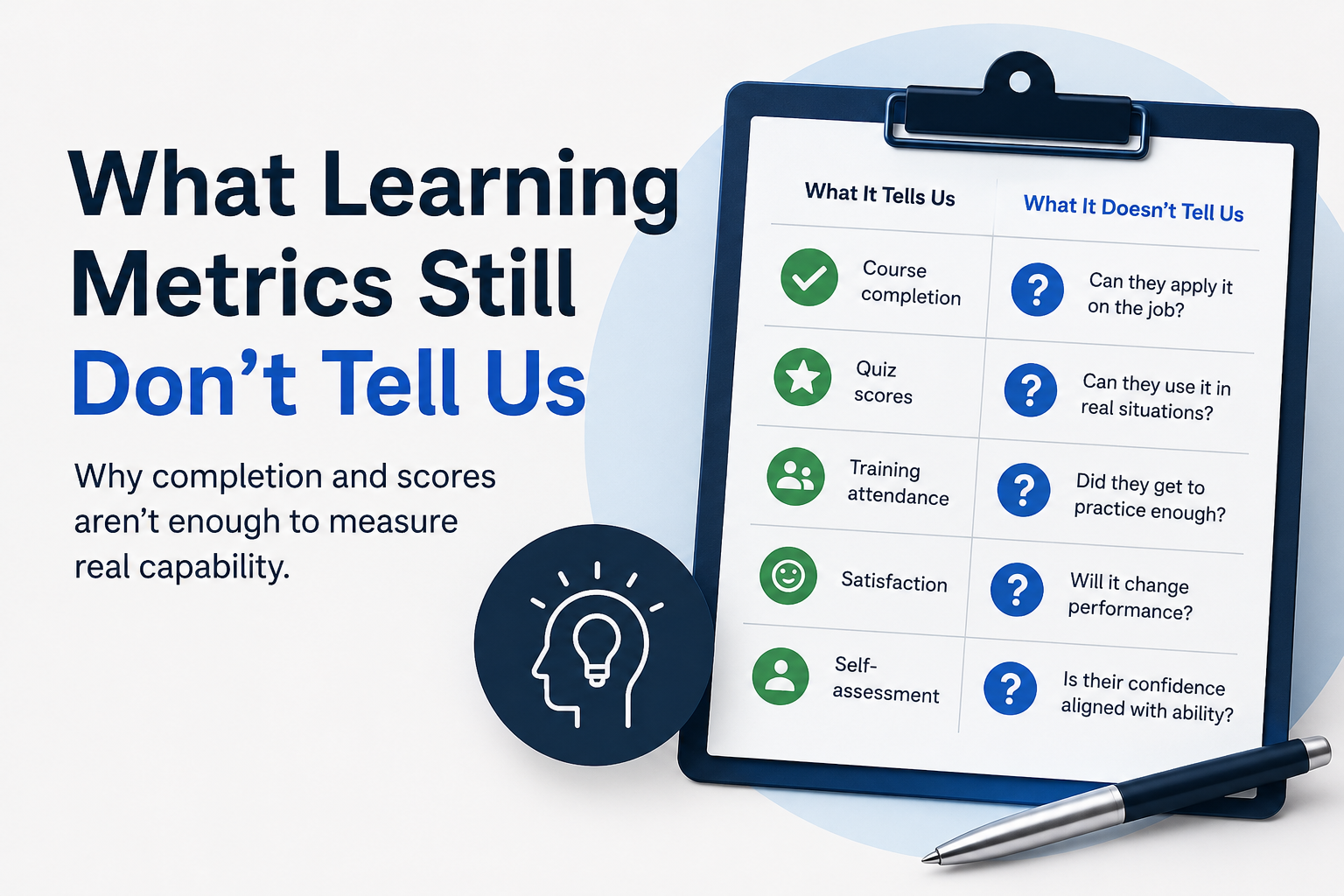
Asking people to rate themselves is cheap and fast. It also gives people a voice, and it shows where they feel unsure.
The limit is that a self-rating reflects how confident someone feels. Confidence and performance often drift apart. Some people underrate themselves. Others do not yet know what good looks like, so they rate themselves higher than their results justify.
Use self-rating as a starting point for a conversation, not as a final score.
Manager review: richer, but narrow
A manager sees a person across many weeks and knows the context. That is valuable.
It also has limits. Managers rarely see every conversation, so they judge from a small sample. They are influenced by recent events and by how much they like working with someone. Different managers also hold different standards, which makes comparing teams hard.
Manager review works best when it is anchored to specific, observable behaviors rather than a general sense of how someone is doing.
Tests: consistent, but about knowledge
Tests and quizzes are easy to run and easy to score. Everyone gets the same questions, so results are comparable.
What they check, though, is mostly recall and judgment on paper. A person can choose the right answer from a list and still freeze in a live conversation. Tests are useful for confirming that people understand a policy or a process. They are a weak proxy for skill.
Observation: closest to the job
Watching someone do the work, or a realistic version of it, gets closest to the truth. You see what they say, how they respond when things go off script, and how they take feedback.
The challenge is scale. Observing every person on every skill is not practical on the job, and live observation can change how people behave. This is why many teams use realistic practice situations. They create a consistent, repeatable way to see how someone performs, without waiting for the right moment to appear in real work.
Combine methods and weigh them differently
No single method is enough. A reasonable approach is to treat each one as a different kind of evidence:
- Self-rating shows confidence and perceived gaps.
- Manager review adds context and history.
- Tests confirm knowledge.
- Observation or realistic practice shows performance.
When these agree, you can trust the picture. When they disagree, that is useful too. A person who rates themselves high but struggles in practice has a different need from one who rates themselves low but performs well. This is also where the idea behind skill building matters. Assessment is not a one-time verdict. It is a snapshot taken during a cycle of practice, feedback, and another attempt.
A short example
Take a team lead who needs to give feedback to a colleague who is falling behind. The lead rates themselves four out of five. Their manager rates them three, because she has heard they avoid the conversation. They pass the feedback-model quiz easily. Then they run a realistic practice conversation, and they spend most of it softening the message until the point disappears.
Each piece of evidence is true. Together they tell a useful story: the lead understands the model and feels confident, but has not yet practiced saying the hard part out loud. The next step is clear, and it is practice with feedback, not another course.
Where to start
Pick one skill that matters for a result you already track. Write down two or three behaviors that show it done well. Then gather two kinds of evidence: how people rate themselves, and how they perform in a realistic situation. Compare the two.
Share the results with the person, give specific feedback, and let them try again. The change between the first and second attempt tells you more than any single score.
myQuest Skills supports this by letting people practice realistic work situations with AI simulations and get feedback, while showing managers progress and gaps across the team.
Next in this series: skill mapping 101