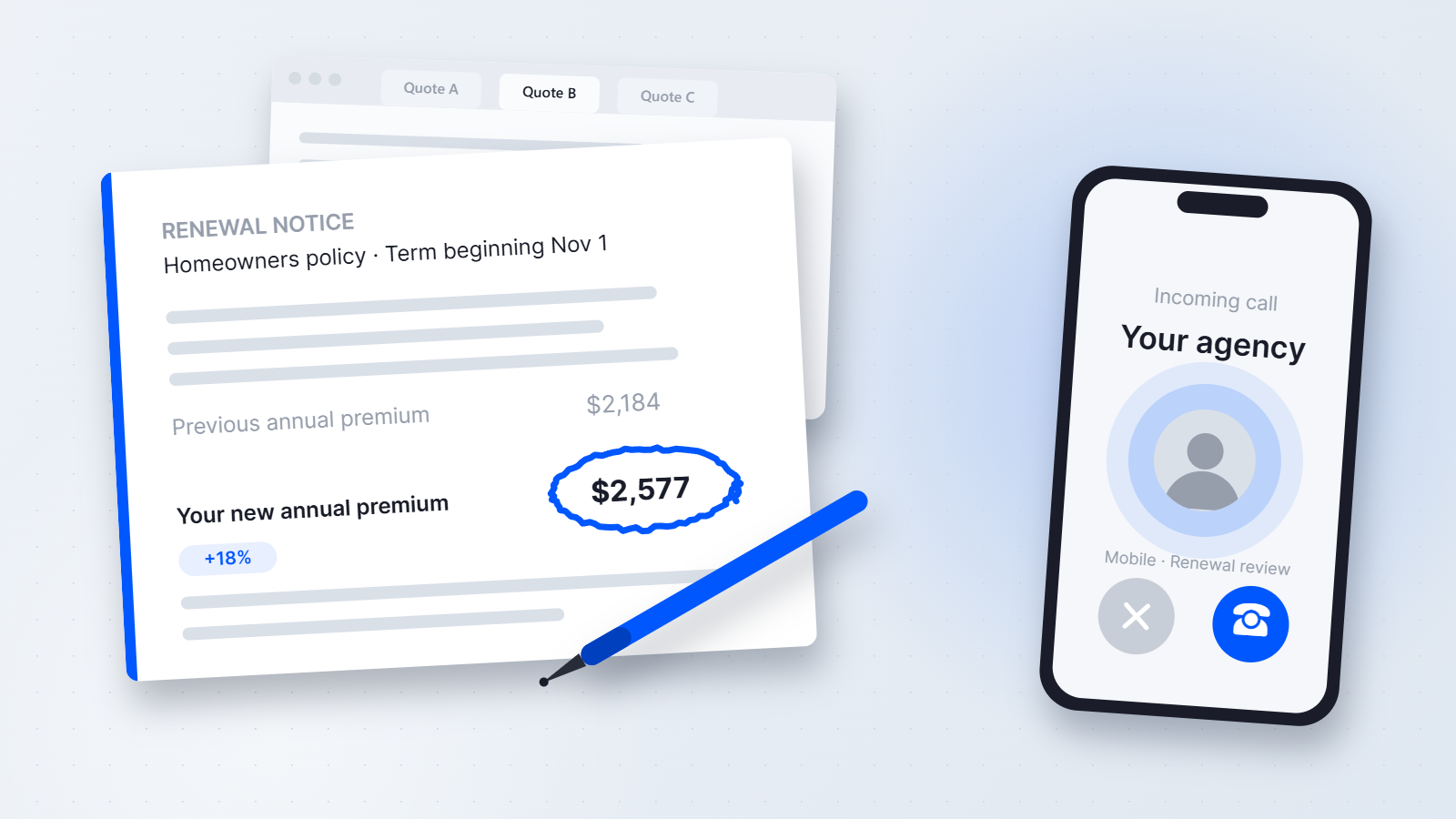
The renewal lands. The premium is up 18 percent, nobody from the agency has called, and the client has three competitor quotes open in another tab by the time they dial your number. Agents describe this call more than any other right now, and they describe it the same way: the client is already gone before the conversation starts.
The renewal rate-increase call is the conversation an agency has with a client whose premium went up at renewal. Retention depends on whether the agent reaches the client first, explains the increase in plain terms, and owns the next step, rather than on whether a cheaper quote exists.
What people are saying
Agents on the industry forums and in trade press keep returning to the same four patterns.
Most agencies still wait for the client to call. A long thread on Insurance Forums opens with a simple question: does your agency contact every personal lines client at renewal, or wait for complaints? The answers split. One agent who worked 60 to 70 renewals a month said calling every client was what set the agency apart. Others said that with renewals now “almost always” a significant increase, proactive outreach is too much for a small shop, so the increase arrives unexplained. (Insurance Forums, Dec 2024)
Remarketing used to be the answer. It isn’t anymore. The same thread describes agencies that once re-shopped any account up 10 percent, or 40 percent, automatically. Now few carriers are writing new business, so the re-shop comes back with nothing, and the agent has to carry the increase to the client with no alternative in hand. A California agent noted that a 10 percent increase, the old trigger for remarketing, is now small. (Insurance Forums, Dec 2024)
Slow follow-up is the real churn. An agent whose agency was acquired by a larger broker said clients who asked for a re-shop waited weeks for an answer, then found coverage on their own. Agency Performance Partners describes the same failure from the consulting side: a four-day delay on a re-shop request, or asking the client to send over the competitor’s quote, which “can feel insulting.” (Agency Performance Partners)
Trust is the variable, not price. In the Medicare market, agents describe clients switching because “another agent told them” a different plan was better, sometimes over small savings, and prospects who are wary of any unknown caller after a season of ads and cold calls. (Insurance Forums, Nov 2024) The 2026 J.D. Power U.S. Home Insurance Study puts a number on the same thing: high customer trust is associated with three times higher intended retention and a 2.6 times lower likelihood of shopping, and only 55 percent of homeowners say they fully understand their coverage. Proactive contact moves that understanding figure up; no contact in the past year moves it down. (J.D. Power via Business Wire, Sept 2026)
These forum threads are from late 2024. The research and the regulation below are from 2026, and they say the complaint has not aged.
What usually goes wrong on the call
Strip the forum threads down and the same three skill gaps show up.
Clarity. The agent can’t explain the increase in terms the client can use. “The market” is not an explanation. Washington’s insurance commissioner now requires auto and home insurers to give policyholders a reasonable explanation of a premium increase on request, in terms the policyholder can understand, with an electronic way to ask starting November 2026 and a requirement to name up to three primary factors from March 2027. That is a regulator writing down what a good agent already does on the call. (Washington OIC)
Empathy, in the working sense. Not sympathy. The client is reading the number as a statement about whether the agency has been paying attention. Independent Agent magazine’s renewal guidance says it plainly: listen without interrupting, then summarize the client’s concern back before presenting anything. Most agents present first. (Independent Agent, Apr 2025)
Ownership. The call ends with the agent holding the next step, with a date, or it ends with the client holding it, which means a competitor holds it. The forum stories about re-shops that took weeks are ownership failures, not pricing failures.
What good looks like in that moment
Across the threads and the trade guidance, the agents who keep clients through an increase do five things, and they do them in roughly this order.
1. They call before the client does. The renewal notice is the trigger, not the complaint. Agency Performance Partners reports, in figures cited by Independent Agent, that 80 percent of clients who spoke with an agent during the policy term stayed, and that most clients who leave never spoke with anyone after the policy was written. Treat those as the consultancy’s own numbers, not an industry benchmark, but the direction matches what agents describe. (Independent Agent, Apr 2025)
2. They name the cause in one sentence. A claim, a ticket, a new roof age band, a carrier’s statewide filing. If the client caused it, say so kindly. If the carrier did, say what the carrier said.
3. They reflect the concern before they answer it. “You’re asking whether we looked at this before it hit your mailbox” is a different conversation from “rates are up everywhere.”
4. They present options before remarketing. Deductible, coverage, discounts, telematics, payment plan. Remarketing when it is viable, and a straight answer when it isn’t, including why the current carrier is still the right one.
5. They close with the next step and a date. Who does what by when. Then they do it.
How you would know your service team can do this
A manager can’t sit on every renewal call, and QA finds the lost client after the fact. The question is whether each person on the team can explain an increase clearly, reflect the client’s concern before answering it, and own the next step under pressure, and the honest answer for most agencies is “we think so.”
A skill map replaces “we think so” with a score. On myQuest, each person practices the rate-increase conversation with a realistic client, and every attempt is scored 1 to 5 on each skill, with the moment in the conversation that earned the score and one thing to do next time. Scores roll up by person and by team, and skills with too few attempts are flagged, so the service manager sees who is ready for the renewal season and who to coach first, before the renewals go out. See how skill mapping works.
Questions agency leaders ask
What should an agent say when a client’s premium goes up? Name the cause in one sentence, reflect the client’s concern back before answering it, present the options that exist (deductible, coverage, discounts, remarketing if viable), and close with a specific next step and date.
Should an agency call every client at renewal? Agents who do say it is their main retention tool. Agencies that can’t reach everyone set a threshold (a percentage increase, or specific carriers) and call those clients before the notice lands, rather than after the complaint.
Is remarketing the answer to rate increases? Less than it was. With fewer carriers writing new business, re-shops often return nothing, and trade guidance now treats remarketing as a last resort after explaining the increase and presenting other options.
Do insurers have to explain premium increases? In Washington, auto and home insurers must give a reasonable explanation on request, with electronic requests from November 2026, up to three named factors from March 2027, and automatic written notice for increases of 10 percent or more from 2029.
Can AI roleplay help agents practice rate-increase calls? Practice with AI characters is how the evidence is gathered. The point is the measurement: a consistent per-skill score on clarity, empathy and ownership for every agent, with the evidence attached, so the manager knows who can handle the call before the renewals go out.
Sources
Does your agency conduct renewal reviews for personal lines, Insurance Forums, December 2024. insurance-forums.com
Hardest Medicare AEP yet for phone sales, Insurance Forums, November 2024. insurance-forums.com
Proactive rate increase phone calls, Agency Performance Partners, 2023 (updated 2025). agencyperformancepartners.com
6 ways to boost client retention with a renewal and remarketing plan, Independent Agent, April 2025. iamagazine.com
Home insurance affordability pressure raises the stakes for customer trust, J.D. Power 2026 U.S. Home Insurance Study, Business Wire, September 15, 2026. businesswire.com
Trust gap is costing home insurers three times the retention, Insurance Business, September 15, 2026. insurancebusinessmag.com
Insurers must explain premium increases, Washington State Office of the Insurance Commissioner. insurance.wa.gov