Most organizations know exactly how many people sit on a team. Far fewer know what those people can actually do. Headcount lives in a spreadsheet. Skills live in scattered reviews, half-remembered conversations, and guesses.
Skill mapping closes that distance. It gives you one shared, visible picture of what a role needs and what people can do today, so the conversation moves from impressions to evidence.
What a skill map is
A skill map is a simple record of two things: the skills a role needs, and how well each person can do them today. Put them side by side and you can see where a team is strong, where it is thin, and where one person's strength could help another.
A map is not a list of course titles. It is not a job description either. It describes what people can do in real work situations, in terms you can observe. If you are unsure how skills differ from related terms, this explainer on skills and capabilities is a good place to start.
Why it matters
Without a map, decisions about training, hiring, and coaching rest on opinion. With one, you can ask better questions. Which skill, in which team, is holding back a result we care about? Who already does this well? Where would practice make the biggest difference?
This links directly to the cost of leaving gaps unseen, which we covered in why skill gaps quietly cost organizations money. You cannot close a gap you cannot see.
Build it in four steps
1. Choose one role and one outcome
Do not map the whole company. Pick a single role, such as a service agent, a sales rep, or a new team lead. Then pick one result that role affects, such as resolving a complaint on the first call or running a useful one-to-one.
2. List the skills that drive that outcome
Aim for five to eight skills. Ask people who do the job well what they actually do. Write each skill as an action, for example "explains a rate change clearly and stays calm when the customer pushes back." Short, observable statements work better than abstract labels.
3. Define what good looks like
For each skill, describe two or three levels in plain words. What does someone new do? What does someone dependable do? What does a strong performer do differently? You do not need a perfect scale. You need one that two managers would read the same way.
4. Gather evidence for each person
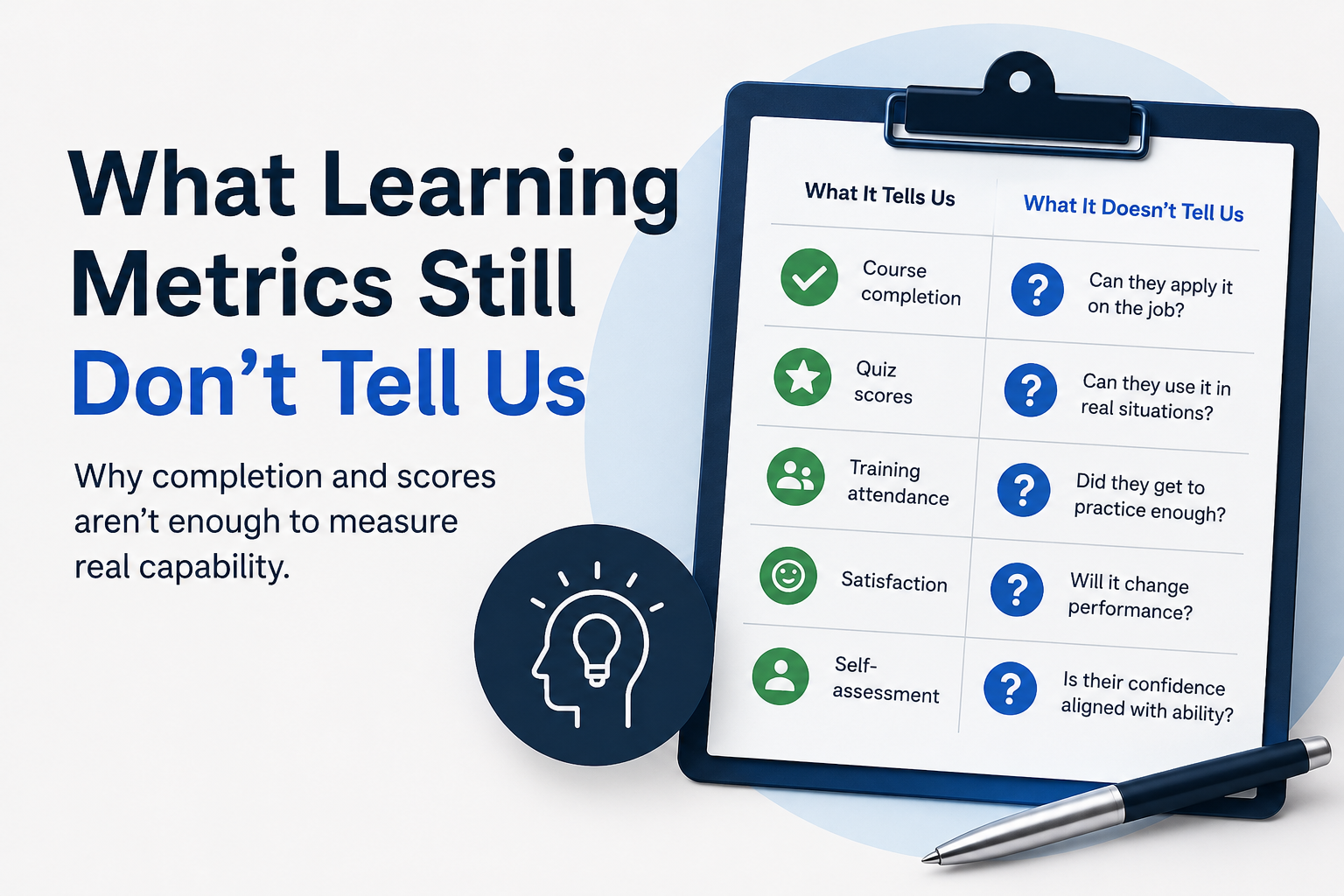
This is where many maps fall short. Knowing how someone feels about a skill is not the same as seeing them use it. As we explained in knowing vs. doing, what people know and what they can do often differ. Combine more than one source, as outlined in how to assess skills: self-rating, manager input, and what people show in realistic practice.
Common mistakes to avoid
- Mapping too much at once. A map with sixty skills per role will not be used. Start small and measurable.
- Vague skill statements. If you cannot picture someone doing it, you cannot assess it.
- Treating the map as a one-time project. People build skills, roles change, and the map needs to keep up.
- Using it only to rank people. A map should point to where practice and feedback will help, not to who to blame.
From map to action
A map is only useful if it leads to something. Once you can see a gap, the next step is practice in a realistic situation, followed by specific feedback and another attempt. Then you update the map with what changed. That cycle is what turns a picture of today into progress you can measure.
Where to start
This week, pick one role and one outcome. Write down five skills that drive it, each as an observable action. Ask two people who perform well whether the list matches what they do, and adjust. You will have a first draft of a skill map in an hour, and a clear sense of where to look for evidence next.
myQuest Skills lets people practice realistic work situations with AI simulations and get feedback, and shows managers progress and gaps across the team.
Next in this series: why training alone rarely changes behavior